Cast and Crew

Showing posts with label eggs. Show all posts

Monday, November 15, 2010

Dark Meat, Anyone?


You may not know much about Dark Meat (whose real name is Esther, named after the famed synchronized swimmer), but you may be hearing more about her over the coming weeks.


See the resemblance? I thought you might. I can't say that Dark Meat enjoys a good swim, but her feathery toes know no boundaries. She's bold, she's brave, and I even witnessed her giving a hearty peck to Portia just the other day. We worried that she would forever be the scared little chicken in the flock, but she seems to be coming into her own.


The real reason we're all about Dark Meat these days is because....
SHE LAID HER FIRST EGG!
That's right, folks. The silence of the egg is over. After a month of no hen fruits, Dark Meat has come through as a shining example of urban-egg-laying glory. Her first egg came early on Saturday morning, and the second arrived on Sunday. Who knows? There might be one waiting for us after work today. So far her eggs are a bit on the small side, but we don't judge around here. Their shells are a lovely pale brown with subtle lilac specks. If I hadn't been so keen on breakfast this weekend, I'd have snapped a pic or two.

It's funny how we've come to depend on our ladies for eggs in the course of just one short year. Store bought eggs simply won't do. The shells are too uniform, the yolks are too pale, the flavor is flat, and the characteristic bit of feather fluff or chicken poo is oddly absent. I've missed me some farm eggs.


Tuesday, November 9, 2010

Happy Anniversary to Us!

Where has the time gone? Really, folks. I mean it. I wake up and it's dark, my train ride to work is dark, the ride home is dark... It's no wonder the hens refuse to lay eggs when the days get shorter. But the specific time I'm referring to today is the year of blogging we've just completed! The first blog post here was on November 7th, 2009, and we've come a long way since those early days. Ready for a trip down memory lane?

Six tiny chicks showed up at the local post office in the late part of summer 2009. It was August, we had just gotten home from a great road trip vacation to Yellowstone NP, Grand Teton NP, and Glacier NP. (This was the vacation where Aimee really got to get in some serious "wheel time" driving the Subaru. I napped in the passenger seat and woke up to find her cruising along at 83 mph in Montana. Yikes!) The coop was nearly finished, and the brooder box was warm and waiting. Portia, Ellen, Raquel, Ursula, Ingrid, and Norma Jean all thrived in those late summer weeks. By December we had our first eggs.

Sadly, we lost one of our chicks in early 2010. Norma Jean, tragically named after Marylin Monroe, died young of an overdose. If only we could have sensed the foreboding in her name. It was a terribly sobering event after such initial success, and it forced us to come to terms with how attached we had become to our little ladies in the backyard.

Bartering eggs around the neighborhood opened up new lines of communication, friendship, and sharing, and we credit the chickens and the garden in the front yard for much of this. One neighbor was so caught up with the beauty of our hens than he asked us to raise a few for him. He built a great little coop and run, and his three chickens are now happy and healthy, and I think they're probably a bit spoiled.

That same batch of chicks brought three new lives into our own flock, though we could never have guessed how much they would teach us or force us to grow over the course of a summer. Winona, the luckiest (or unluckiest) little Wyandotte I have ever known, started out a little slower than her brooder box mates. I dropped a board on her and nearly killed her, but she simply refused to give up. After a few days in isolation under a heat lamp, she rejoined her sisters and has grown up to be pretty close to normal. As it turns out, her inability to prevent getting whacked by me is probably related to her scissor beak condition. To this day, her beak must be clipped regularly, her eyesight leaves a lot to be desired, and she's extremely shy about portait shots with the camera. Though she consistently peck an inch to the left of snacks on the ground, she's a fighter. In other words, she's really darned plump.

Dark Meat is the embodiment of pure joy. I have yet to capture a video of her antics, but believe me that it will be worth the wait when that movie shows up. Perhaps a dedicated post to our funniest chick is in order soon. Neither of the two youngers chickens have started to lay eggs, and this Friday they will be 33 weeks old. They seem to have the support of the toughest chicken union I have ever negotiated with.

Rusty, formerly known as Milla, was the most robust, beautiful, and biggest chick we had ever seen. We remained firmly in denial about his gender until the infamous "borkle" sound I heard one afternoon. We struggled with our decision to slaughter him, and we learned so much about respect and personal limits, none of which were anticipated. Though we have received some criticism about butchering our own animal, it was an important step for the future farm we will someday own. On a personal level, slaughtering an animal I genuinely loved has changed my internal compass for eating, and it has opened my eyes to behaviors and practices I feel I can no longer ignore.

We cut down the massive, very old, and incredibly frail douglas fir in our front yard during the peak of the summer heat. That seemingly simple act has opened up a world of possibility for our small raised bed garden, and we are now looking forward to more work, more harvesting, and more sunlight in our future.

What's to come in the future? If we have learned anything in the last year of urban farming it is that planning is fun, but the farm will make its own decisions with or without our input. Below is a list of hopes, and some of them feel a bit like New Year's resolutions, which is to say that fulfilling or ignoring them are both viable options.

  • Honey bees are the next big goal. We'll be starting out with a single hive in the front yard in the spring, and we hope to learn much about the lives and organization of bees, pollination, listening to the weather, and collecting honey.
  • Meat birds are the next logical step after Rusty. Though this particular item is under some heavy scrutiny at the moment, it will eventually happen in the coming years, even if next year is not good timing.
  • The garden shed will be getting a concrete floor, and we hope to have this completed before the end of 2010. Both it and the garage could use a lot of love and work, but we'll handle that one project at a time. In the meantime, we need a safe place for storage, and we're looking forward to growing more of our garden starts under cover.
  • The reclaimed "acreage" in the front yard needs to be converted into beds and a mini orchard. Building raised beds can be a lot of work, but we've had such great success with those that we already have, and Aimee really wants a place to grow raspberries. I'm hoping to rig one or more of them to accomodate a mini hoop house for tomatoes, cukes, and possibly some other fun veggies.
  • The line of stumps in the backyard is gone, thanks to the fine efforts of the chickens. A second mini orchard may find its home there.
  • Our parking strip is the last vestige of grass (by which I mostly mean weeds and clover) in front of the house. One bed of herbs is already planted, and at least four more are planned. In my mind (as idyllic and ridiculous as it is known to be), I imagine our neighbors casually wandering over to clip oregano and parsley for their dinners in the summer evenings. In reality, I am prepared for more than a little cat poop.
  • Many of the bedding plants around the house are going to be removed and re-homed to make way for rhubarb, berries, and who-knows-what-else. We both agree that the calla lilies are waning, the single mum doesn't get enough light, and the dhalia always gets infested with aphids. It's time for edible permaculture.
Are we too ambitious? Probably, but it's always funny to watch us try. Stay tuned over the next year to see what really gets done. What are your plans for gardens, farms, animals, and such?

Tuesday, November 2, 2010

Get Out And Vote!


The campaigning has hit its peak. Signs are in yards everywhere, the TV and radio are buzzing with promotional ads and digs at opponents, and some of us have even been visited (repeatedly) by Labor Neighbors. If you have a union job, you've probably heard of this door-to-door process. If you haven't, be thankful. In the spirit of exercising your rights, we encourage you to vote today. A brief review of the key issues is below, and our recommendations are noted.

  • Referendum Cluck - We, the chickens, hereby propose an increase in food, wherein food is defined as any wholesome substance to be deposited in our communal feeder or distrubuted about the floor of the run. Desired natural foodstuffs include such things as fresh berries, cheerios soaked in whole milk, a hot oatmeal breakfast on cold days, and leftover carrot and turnip mash.
Vote for - That raw food stuff is for sissies. We're tired of brussels sprout stalks and crunchy pumpkin innards. Cook it, already. (Sponsored by Real Chickens for Real Food)
Vote against - You're lucky you get anything but chicken feed. (Sponsored by Humans Don't Have Enough Time to Cook For Themselves, and They're Not About To Cook For Birds)

  • Initiative Egg - We, the humans, hereby demand a shift in the molting schedule of the hens. Summertime is hot, which means it is a much better time to shed feathers and regrow. Additionally, our egg demands are greatly reduced from July to August. We propose that this new molting period become effective immediately to help restore critically low funding in egg capital for holiday baking.
Vote for - Really? You stop laying right when we need eggs the most? This union bullying tactic has gone on long enough. You're shivering and we're having to purchase eggs at the store. (Sponsored by The One Person in the Family Who Would Like an Omlette for Breakfast)
Vote against - It's about damn time you realized you need what we work so hard to produce. We hope you enjoy that lifeless, pale yolk you had in your scrambled mess this morning. (Sponsored by Unified Chickens for an Egg Unrestricted Market)

Well, folks, that wraps up our suggestions and comments on this important voting day. Every voice (and cluck) is important, so let your choices be heard. The poll is now open (on the upper right side of this page). Polls close in one week, so vote early and often!

Wednesday, October 20, 2010

No Feathers, No Eggs


It's been a sad time around the urban farm lately. Egg production has never been this low, even when the girls first started laying. We feel lucky to get one egg per day, and that egg is most certainly coming from Portien. Who is Portien, you ask? She would be either Portia or Ellen, one of the Hamburgs. We honestly cannot tell them apart anymore. They are most frequently observed as a high speed flash of polka-dotted-black-on-white streaking through the yard or darting into the coop. Let me back up a bit in the storyline.


When we first decided to raise chickens, I began researching which breeds of chicken to purchase. I knew I wanted heritage breeds. I knew I wanted friendly chickens that would be easy to handle. I also knew I wanted three different breeds, two chicks of each. I hoped this would leave us with at least one of each type after any fatalities or problems in young chickenhood. I was nothing if not realistic. I was also, as it turned out, a bit misguided in my breed selections. How do you choose when there are so many varieties of hens? How do you narrow down the many types you'd like to raise into just three options? I struggled with my wants and needs, I studied pictures of hens and chicks for weeks, and I finally decided on the three we would eventually order.

Dominiques

Golden Campines

Silver Speckled Hamburgs

The list of runner ups included Delawares, Brahmas, Sussex, and Welsummers, two of which ended up in our second batch of chicks early this year. Basing your decision on a website description of breeds is tough. As many of you probably know, breed characteristics come second to the many unique qualities of an individual. It's great to say that Dominiques are friendly birds, but you don't know how your birds will behave until you have them in your coop. I also feel that how you raise and handle your birds plays a large role in their later interactions with you and others. That said, our decision to bring in two Hamburgs was not the best, nor was it based on accurate information.

I told you they were molting.

The cons of Hamburgs:

Hamburgs are one of the most notoriously flighty birds you will encounter. They do not like to be handled. They will avoid being caught at all costs. And, for those of you who've been reading this blog for any length of time may recall, they can fly very well. Catching Portia or Ellen is a skill that has taken a lot of time to develop. I am grateful for one thing: they are bird brains.

Hamburgs don't like to be confined. This is great if you have plenty of room to let them wander, but city chickens usually equal confinement to a coop for much of the day. Once they're out, you're best to just let them find their way home at sunset.

Ellen (or Portia) stares longingly at the loaf of bread. Good luck, skinny bird.


That flightiness I mentioned before necessitates wing clipping every year. This is a valuable skill, and I'm glad to have learned it, but it prevents you from being able to show your birds at events, which is one of the main reasons people choose to keep Hamburgs. They are truly beautiful animals.

Our Hamburgs suck at foraging. I swear. You can tell by the color of their egg yolks. Portia and Ellen's eggs are the lightest in color of all the eggs we collect from our hens. The Dominiques lay the darkest yolks.

The pros of Hamburgs (or, What This Post is Really About):

This bird is sometimes called the Dutch Everyday Layer, and they got that name for good reason. They will honestly lay six eggs a week, unfailingly. In fact, as I mentioned above, they are currently our only source of eggs. We can't tell the difference between Portia's and Ellen's eggs (and, yes, we can tell all the other girls' eggs apart), but there is almost always a lovely, shiny, slightly creamy colored egg in the nest box. Sometimes that egg lands in the compost bin or behind a thorny thistle we forgot to pull up, but these girls are the most reliable layers you will ever meet.

If you do choose to let your Hamburgs out (which we do, due to the afore-mentioned wing clipping), they stand a better chance of escaping potential attacks from predators than the rest of the flock. As I said before, they're impossible to catch. This can be helpful if you have neighborhood racoons, opossums, cats, dogs, etc.

Why aren't the rest of our ladies laying? Molting. And when I say molting, I cannot emphasize enough how bad these chickens look. After plucking dear little Rusty earlier this year, I am reminded of that event every time I see Raquel. She looks like she's nearly ready for the stew pot. Molting is tough on a hen. The protein required to grow all those feathers back makes her moody and hungry all the time, and her body can't keep producing eggs when it's stressed like that. I've heard loads of methods to speed the process up, but I think this is one ailment that only time can heal. Meanwhile, we haven't given out surplus eggs all month (because we haven't had any). The neighbors have been worried. My breakfasts have been boring. Baking makes us worry that we might have to (*gasp*) buy eggs on the open market. Those chickens aren't the only ones stressing in this family.

Dear God, that is one awful-looking chicken. Poor Raquel! She's already half plucked!


On the bright side, Ursula has grown her tail back, her feathers are looking lustrous and full-volume again, and I think she may be contemplating laying once more. Also, *someone* has been doing a lot of nesting in the upper coop. The wood chips are routinely scattered into drifts, and little hollows have been made in corners. Could Winnie or Dark Meat be thinking about laying?

Monday, September 27, 2010

What's For Dinner??

Chickens are omnivores. They'll really eat anything. Sometimes they even look at me with those beady little eyes, and I wonder if I'm on the menu. But seriously, this time of the year many chickens are molting, and the loss of all those feathers makes them ravenous. Our three pound feeder gets emptied twice a week by our seven girls, so we have to keep an eye on it to make sure they don't start chewing through the coop wire to get at the fridge in our kitchen.


We recently procured a couple of large metal bins for storing chicken feed. Why? Rodents, of course. Our garden shed was once the Hilton for a couple of very plump mice. They got into the food, the cracked corn (for treats), potting soil, garden seeds, fertililzer... You name it, they wrecked it. Solution? Metal bins, and a new concrete floor in the shed. The floor won't be done for another couple weeks, but the metal bins are a great way to put an end to the mousy frivoloties. Each of these bins has a thirty gallon capacity, which means they can each comfortable hold two fifty-pound bags of feed. The one in the foreground here has that amount in it, and you can see how much room is left. Bear in mind, this means that each bin will weight over one hundred pounds when full.


The lids fit snugly, and we have yet to experience any problems since using the bins. Price your local co-op and hardware store for the best deal. We got these for about $28 each at the big chain hardware store a mile from the house. They beat the local co-op by two bucks.


Buckets with tight-fitting lids also work well, but rats have been known to chew through plastic when desperate. Ours have held up well, but we're also careful to keep them in areas with lots of activity and foot traffic. Shifty little rodents prefer dark corners and quiet places to perform their acts of pilfering. The one pictured above is home to our supply of weed seeds.


Weed seeds? Really? Here in our little urban farm, we like to call ourselves frugal (aka cheap). Why pay for something when you can trade, barter, or get it for free? One of our neighbors works at the Snohomish County grain facility. Farmers bring in their grain, it gets ground, and the waste (weed seeds, hulls, bits of wheat, etc) falls to the floor. That neighbor expressed an interest in getting a herd of chickens to roam around and eat all that good stuff that was getting thrown away. Better solution - We'll take it! We mix this in a 1:2 ratio with their regular feed. The girls love it, it gives them extra protein and variety in their diet, it cuts down (a little) on feed cost, and it keeps perfectly good grain out of our county waste facilities.


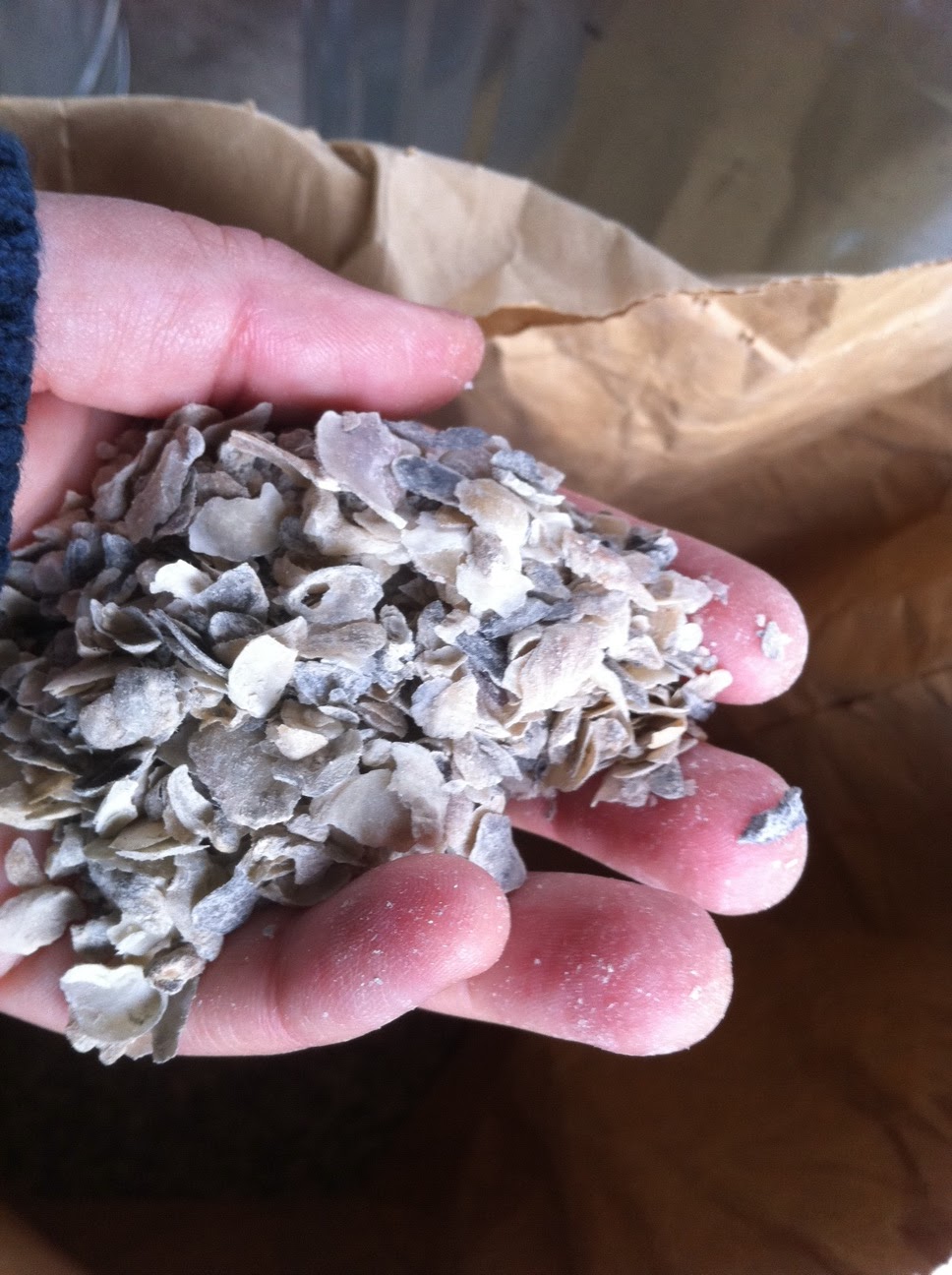
We also add oyster shells to our ladies' meal plan. I've tried several ways of providing them with these shells, but the least messy method I've used is to incorporate it straight into the feeder. This gets mixed at a 1:4 ratio with the standard feed. So filling the feeder is easy. Four scoops of feed, two scoops of weed seeds, one scoop of oyster shells. Repeat.


A bag this size will last a long time. We've had this one for a year already, and it's still 3/4 full. And heavy!! Ground up oyster shells are also great in your garden. They repel slugs and other soft-bodied pests, and they provide a great source of calcium and magnesium for plants. We don't bother since there are loads of egg shells to fill that need in our raised beds. 


Last, but possibly most important, access to fresh, green grass is really important to the dietary health of a chicken. Apart from fresh air, space to run and flap, crunchy insect snacks, and mite-busting dust baths, getting outside lets your chickens feel like chickens, not nuggets in a cage. If you can't let your hens out, or if the weather is just too nasty, make sure to give them plenty of treats to snack on. Cabbage leaves, melon rinds, and loads of other scraps from your garden and kitchen give them variety to nibble on, and they cut down on aggression during times of confinement. Chickens (like cows, sheep, and many other farm animals) also have the ability to digest grass and turn it into an edible product for humans to consume. This is our best way to get Omega 3 fatty acids. Check out this article from Eat Wild for more information on the benefits of consuming meat and eggs from grass-fed animals. The more they roam in the yard, the darker our hens' egg yolks get, and that's the whole reason we wanted to raise chickens in the first place.

Monday, July 12, 2010

The Gem of the University District

This is the first in a series of posts about the Puget Sound farmers markets. We visit a few different ones each week depending on what we need, which market has something unique, which day we can scamper off with canvas bags in hand, and where we plan on being that day. You never know which market you'll find us at, but keep your eyes open and say hello if you spot us! To find the farmers market closest to you, or to go on adventures like we do, check out Puget Sound Fresh, Seattle's Neighborhood Farmers Market Alliance, or Snohomish County Farmers Markets.

The University District Farmers Market is a great chance for people in the city to get to know their growers up close and personal. Located in the parking lot of the University Heights Center for the Community, at the corner of University Way and NE 50th Street, the U District market keeps going year round.The following shots were taken about two weeks ago on a cloudy, very typical Seattle day. That didn't deter the crowds one bit. For anyone concerned about the popularity of farmers markets, look no further!
Tomatoes are finally coming in, so salads don't have to be boring anymore.
Brightly colored swiss chard seems to make everyone smile.
Hothouse cucumbers are likely to jump into your bag before you realize it. They're worth stopping for.
Who doesn't love a towering pyramid of baby carrots? The big carrots won't be in until much later, but these tiny spears of orange brighten up salads and cole slaw with crunch and mild flavor. Have you ever thought about how cheap carrots are in the grocery store? Try growing them at home and you'll quickly see that the effort they require should generate a little more income.
Rainier cherries are everywhere this time of year. Lighter and easier to eat by the dozen, these pacific northwest classics belong in your lunch bag for as long as you can keep them.
While we're not big fans of bing cherries, they sure do add a punch of color you can't ignore.
Tumbling peas and perky broccoli provide plenty of ideas for summer salads, lunches, dinners, and creative quiches. Don't be afraid to try something new. You may just decide you like kohlrabi, celeriac, or rutabagas. If you're wrong, your chickens, compost bin, or worm compsters will help you move on.

Toboton Creek Farm is a great source of boer goat, and their eggs are HUGE!
If you have yet to try goat, stick to something safe and easy. We tried goat bratwurst first, and we fell in love. Four in a pack will set you back $16, but they're absolutely worth every penny. Ask for them early before they sell out.
Berries are everywhere. If you can't make it out to a u-pick farm, be sure to buy them by the half or whole flat at the farmers market. Rinse, slice, add plain yogurt (from a local dairy, of course), sprinkle with granola, and make all your co-workers jealous as you feast after staff meetings. We go through a full flat of berries every week, topped with Grace Harbor Farms' plain yogurt. Our local co-op even stocks some locally produced granolas. Could everyone stop including coconut though? Some of us are allergic.

After watching Aimee drool over those raspberries, I knew they wouldn't last long on the car ride home.
If you haven't started making batches of jams and preserves, the time is ripe! Always be sure to ask local berry farmers if they'll give you a discount for buying lots and lots (like the three half flats we brought home yesterday), or if they have any slightly squished fruit which is still perfect for jam.
We've been blown away by the juices, ciders, wines, and vinegars available from Rockridge Orchards, and you'll be a convert, too. They provide sips of all the juices they sell, and those gorgeous bottles are good for a deposit on your return visit. We're never going back to the soulless vinegars sold in commercial grocery stores now that we've tried their apple cider vinegar.
Have you ordered your heritage turkey for Thanksgiving yet? Jerry and Janelle at Stokesberry Sustainable Farm in Olympia are happy to take your order now. We have a turkey reserved (which requires a small deposit and a smidge of reliability), and we're hoping to convince our extended family to go local for our feast this year.
Olsen Farms is a great place to pick up grass-fed meats. They're extremely helpful and willing to talk about their products, so don't be shy!
Yeah, I know what you're thinking. Grass-fed meat is pricey stuff. Before you turn up your nose at a $15 per pound top sirloin, think about what goes into the beef you consume. Grass-fed animals are happier, healthier, and their meat is better for you. Not only does grass-fed meat provide you with a great supply of omega 3 fatty acids, it also leaves your full belly with that warm, satisfied feeling of doing something right for cows, farmers, and the environment.

Tuesday, June 8, 2010

A Letter from a Chicken

Dear faithful bog readers:


Lately there has been some very bad press about a rooster on the City Chicken Farm. I'm here to clear that bit of libel up for everyone. My name is Milla, not Rusty. I am a girl chicken. Sure, I have an impressive comb and wattles, and sometimes I... ahem... crow a little bit, but making specific (and incorrect) assumptions about my gender is wrong. It's... genderist. I'm here to set the record straight. I would like to present chickens' exhibit A, otherwise known as "ha, ha, you were wrong."


There you have it, folks. This is indisputable evidence on my behalf. It took half a day to spit that sucker out, and I know it's a little under-sized, but I'm a very young pullet, so it stands to reason that my first eggs would be smallish.


You may not realize it, but the newer generations of chickens are under a lot of pressure these days. Laying eggs earlier is all the rage. I submit my experiences humbly and ask that you think before you begin labeling your chicks as "male" or "female." You cannot possibly fathom how it affects our psyche. Thank you,

Milla Girl-Chicken


Note from actual blog representative:


We think it actually came from Ingrid, which stands to reason after her latest escapades. More on that soon. In the meantime, it seemed equally logical to call this "Rusty's egg," his last ditch effort to save himself from the basting brush. You be the judge. 


PS- He currently weighs 3 pounds 9 ounces, and is twelve weeks old. Recipes are welcome.

Wednesday, March 24, 2010

Animal (chicken), Vegetable (Apple), Miracle (Birthdays)

I've been reading a lot over the last few weeks, what with school slowing down for finals and spring break. It's nice not to feel bound by course requirements, even if it won't last. Math 141, Chemistry 121, and Political Science 101 begin next Monday. I'm cramming in the garden books while I still have free time. Here's a list of what's captivated my attention so thoroughly this spring.
Animal, Vegetable, Miracle is an endearing journey through a family's year of local eating. I've found myself laughing along many times. This book (and its website) contain a number of tasty-looking recipes for eating local produce and meats that are in season. I doubt I'll get Aimee to choke down anything with eggplant in it, but I'm always eager to try new dinner menus.
Okay, you knew sooner or later I'd have to admit being a Michael Pollan junkie. I originally got hooked by The Botany of Desire, which is a great read. The film version of it was on PBS not that long ago, and it was equally enthralling. What I enjoyed most about In Defense of Food was its semi-cynical manner of breaking down and discrediting every major diet fad America has known, including the one proposed by Michael Pollan himself.
I followed Jenna's blog for a few months before finally wrangling Made From Scratch from the clutches of the Everett Public Library, and it was worth the effort. Again, this was one of those books you chuckle along with as you read it on the bus or train, but I can't say she's got me convinced to playthe hammered dulcimer just yet. I will admit that her trials and errors with chickens alone made me feel like a truly accomplished urban farmer (seeing as we currently have an 83% survival rate amongst our hens).

All of this reading has got me (and, to some extent, us) thinking about eating more locally and more seasonally. The eggs from the backyard are great (our monthly tally is already over 100 for March), and I know we'll have plenty of produce from the garden in the front yard come July and August, but we'd like to go further. The Everett farmer's market doesn't start up until June this year, so these changes are going to require thinking outside the box.

Do any of you eat seasonally and locally? How about some advice for the novice!

Today is also my birthday. While their importance decreases over the years, birthdays should still be infused with a bit of fun. One present (though it wasn't intended as such) arrived on the porch while we were out walking the dogs this morning. Two of our older computers are being replaced with a new iMac. This thing is so huge I think we'll need to build a new desk for it. I can't wait to get home and play with it!! Additionally, the much anticipated weekend of Seattle Tilth classes is almost upon us. I've signed up for two classes: Goats 101 on Saturday, and Muchroom Cultivation on Sunday. What kind of wine goes best with chevre and porcini mushrooms?

Wednesday, March 10, 2010

Egg Report Cards

When you have five chickens in your backyard, especially if it's your first foray into the world of urban farming, expectations are a dangerous thing. When will my chickens start laying eggs? How big will they be? Will the shells be soft or hard? And, the biggest question on any urban farmer's mind, just how many eggs will I collect from these hens? After spending the last eight months with our happy girls, we've learned a lot about all of these questions (and more we thought we would never ask). And so, after a little over two months of egg production, the first report cards are out.

Raquel- Being one of the first chickens to lay lovely little brown eggs around the holiday season, Raquel has won us over with her consistency. Her eggs have some of the darkest, orange yolks I've ever eaten. Raquel produces approximately six eggs every week. A+

Ingrid- Small but mighty, Ingrid lays eggs that display the largest ratio of egg size to body weight I've heard of. We collect about four eggs per week from her. What she lacks in production she makes up for in supervising everyone else. That clucking and squawking sound coming from the coop? It's not the chicken laying an egg, it's Ingrid observing the act. A-

Ellen- We started collecting eggs from Ellen in January, and we've been quite impressed with how many of these strikingly beautiful eggs she puts out. We get about six eggs every week from Ellen, and their shells are slightly off-white and creamy. Yesterday she spent over an hour in the nest box laying the perfect egg. It was well worth the wait. A

Portia- Most improved chicken award!! Yes, she's earned it. The last to lay, Portia has increased her production from two eggs per week to nearly five. B+

Ursula- What can we say about Urs but DAMN! She may have the smallest comb and wattles, but she routinely plops out double yokers. Don't believe me? Here's the evidence, folks. Every two weeks, rain or shine, we find one of these in the nest box.
Seriously, this thing didn't even fit in the egg carton. I could barely close the lid. I was forced to stare at it for three days before I could crack it open (alas, early morning shifts don't lend to hot breakfasts).

Yummerific!! While we love the eggs from all of our girls, the best yolks are from the Dominiques. Ursula, you've earned your A+. Good work!!

In total, we collected 90 eggs in the month of February. So far this month we're up to about 37 eggs. What's a farmer to do with all these yummy treats? Well, we're currently selling some and bartering with the rest. Overall, we endeavor to keep most of what we grow and produce in our own neighborhood. That's the essence of eating local, and a 100 foot diet is even better than a 100 mile diet if you ask me. Are you in the 'hood? Stop by some time to visit the girls and nab some fresh goodies. This is local farming at its best.

Tuesday, February 9, 2010

Soft-Shelled Eggs and Raised Beds


While it may be early February, every now and then we get a nice day to spend outside. Yesterday and today are a couple of those marvelous days. The girls, pictured above, nearly trampled me to get out into the yard. They've done a good job weeding, eating bugs, scratching, aerating the soil, and removing the excess worms who wander to the surface after a hard rain. They'll be hard at work again today, so, while they scratch and peck, let's catch up on what's happened over the last couple of weeks.

Ingrid is now laying beautiful, white shelled eggs on a regular basis. We're collecting about 18 eggs per week from three hens, two browns to every one white. Her eggs are very normal now, but we took a few photos of the last soft-shelled egg, which also delighted (and creeped out) the neighbors. There's nothing like holding one of these in your hand. It's such an odd sensation. To better describe just what a soft-shelled egg is like, the following photos should provide some insight. This one is a day old, which accounts for its saggy nature. All eggs loose moisture through the shell over time, but a soft-shelled egg is far more susceptible.

Yep, I really did pick it up by pinching the shell. Ew. We later broke this one open and fed it to the dogs. I was a little too yucked out by it to eat it myself, and Aimee doesn't eat eggs. The shell was so thin and soft that it felt like a flower petal. I was amazed that something so delicate could hold all that yolk and white within.

In other egg news, we believe that either Ellen or Portia has begun to lay. We collected three eggs last week, and two of them were white. Though the pictures cannot do it justice, this new egg was very different than what Ingrid gives us. Its shell was perfectly egg-shaped, hard, and clean, and the color was golden.

The one in the middle came from Ellen or Portia, whose names can be meshed into "Portien," which sounds like portion. This one was laid Friday, February 5th, and we haven't seen a second one yet. For all the horrible things we've said over the past few months about our Hamburgs, at least we can now say they are laying. They still have a long way to go to redeem themselves. 

* Side note: Both Ellen and Portia now have their wings clipped. I'll post a little more about this later, but for now, everyone is grounded, and I am getting much less exercise.


Now that February is in full swing, our One Small Change for the month is also well on its way. If you didn't see our change for January, you can view that post here. The compost is coming along nicely, and I'll be turning it again later today. It should be ready for the garden in about three to four weeks. 

The next change we are taking on is to increase the amount of food we produce here on our own tiny plot of land. We want to be more self-sufficient. We want to eat salads from the front yard. We want to make potato salad from our own potatoes and onions. Ultimately, I think we can provide about 10 - 25% of our own food for an entire year, which isn't bad for a city dwelling couple. In that last picture you can see me assembling another raised bed. Aimee and I finished two beds yesterday, bringing our total to seven. The others are behind me, and one includes a cold frame made from an old window from the house. I'll be planting a very early crop of lettuce, salad onions, and snap peas in there later today. Cold frames give little plants a boost of warmth, which allows you to plant things outside as much as four weeks early. This year we'll be growing things early and late in that bed, which could extend our growing season by two to three months. The fescue and herbs I started last year have been hunkered down in the cold frame since early January, and they are ready to be transplanted.

Sunday, Aimee and I played hookie from work and went to the Northwest Flower and Garden Show. We saw some great exhibition gardens, oohed and ahhed at the goats in the Seattle Tilth exhibit, and marveled at all the people interested in bringing chickens into their lives. Three of the exhibit gardens had chickens in them. While many of these gardens focus on contemporary design or urban loft style, some of them are more geared towards urban sustainability and recycling. There were water gardens, rooftop gardens, living walls, container veggies, and more. This year seemed very much aimed at what a small plot can produce, which seems appropriate during bad economic times. And, following this trend, our neighbor across the street now wants his own chickens. I'll keep you posted on this development.

LinkWithin

Related Posts with Thumbnails