Cast and Crew

Monday, October 11, 2010

Hangin' in the Coop


Your favorite personalities are back! In their video premiere, Ingrid, Dark Meat, and Winnie are the stars.

Since the summer has flown by, I'm sure you're all amazed to see how big and fluffy the babies have gotten. No eggs yet, but we've gotten a lot of laughs watching them flap, flop, and get pecked by the big girls. Is it really fall already?

Okay, okay, I'm obsessed with my new iPhone. But seriously, shooting video from your phone while you're tossing veggie scraps to chickens is AWESOME. You should try it. 

Thursday, October 7, 2010

New Neighbors?


Okay, he's hard to see, but he's there. He's staring at me. And his brother is hiding behind him. Two adolescent racoons have taken up residence in our neighbor's wood pile. I'm torn between thinking they're cute and fearing for our chickens' welfare.

As the neighbor and I discussed this dilemma, we began to wonder what right we had in considering "removal" of these two critters. After all, racoons and other animals are simply a part of urban life. In fact, you're far more likely to see a racoon in the city or suburbs than out on a hiking trail. My block is their block. My yard is their yard. My garden and my neighbors' trash are their sources of food, and our structures have become their homes.

How do you protect your flock and still find the capacity to respect nature's need for wildness?

Wednesday, October 6, 2010

Busy Bee Plans


Last Saturday I took a class on beginning beekeeping. I had a great time. Washington State University runs all of the agricultural programs in the state, and, together with the Washington State Beekeepers Association, provides opportunities for people to take classes in varying levels of beekeeping skill. Becoming an Apprentice Beekeeper requires one eight hour class or a series of five two hour classes in which you learn the basics of bee entomology, hive culture, honey and comb collection, pest and disease management, and the bee geek language. At the end you take a test. A score of 80% in each section is required to pass. Here in western Washington, there are a number of different club chapters that put these classes on throughout the year. Mine was sponsored by the Northwest District Beekeepers Association, which mainly serves Snohomish County. Our teacher was Jim, owner of the Beez Neez Apiary and Supply in downtown Snohomish.


Have any of you taken one of these classes? Do you raise honey bees? My class was pretty intense. There's a lot to cover in just eight hours, and it's tough to get all your questions answered in that span of time. Below are some of the things I learned that seemed most interesting or most important for our first venture into the world of honey.


Jim from Beez Neez placing a frame of bees, comb, and brood into his new display hive. This hive will sit in his store throughout the year so that people can come in and watch the bees through the glass. They're connected to the outside world by a clear plastic pipe on the left side of the hive box, which feeds into a second tube in the side of the building. When Jim finished, he rolled the hive back into the store.

  • Bees regulate the temperature in their hive. How do they do this? A group of individual bees will sit at the bottom entrance of the hive and flap their little wings like mad. This pushes cool air up into the hive and gets the hot air moving out. In the winter they can keep the core of the hive at about 87 degrees. It may be chilly outside, but the bees inside huddle into a clump to keep warm. For this reason, it's really important not to open your hive unless it's over 50 degrees out. And you shouldn't try to inspect brood comb (where the little babies are growing) unless it's at least 60 degrees.
  • Bees don't function as individuals. I can think of lots of Star Trek themes that fit this very well. Rather than consider their own needs, the bees will function as a unit, doing whatever will benefit the hive most. Therefore it makes sense that much of a bee's life is sacrificial. A sting to protect the colony ends their life. Mating ends a drone's life. It seems cruel to us, but it's natural for bees to operate this way.
  • A varied diet is a balanced diet. Bees need to collect many colors of pollen to get the protein and vitamins they need to thrive. When commercial beekeepers use their colonies to pollinate crops like sunflowers, the bees end up with severe nutrient defficiencies. Most bees will find what they need on their own, and you can check what kind of pollen they're getting into with a pollen collector. Some people will even pay big bucks for bee pollen!
  • When laying eggs, the queen bee can decide the gender of her offspring. If she lays a fertile egg, it will become a female. All unfertilized eggs become drone males. How about that.
  • Propolis, or bee glue, is one of the key ingredients in the varnish on a Stradivarius violin. It will also stain your clothes if you're not careful.


You can't imagine just how much info got crammed into my little brain. I still need to take my test and mail it in for my Apprentice certificate, but there's time. Hive and bee orders don't need to happen until early in the year, so now is the time to plan. What kind of hive should we try? Traditional Langstroth or something more like a top bar hive? One hive or two? And, most importantly, where do we put our hive(s)? We still haven't firmly decided to start keeping bees in the spring, but taking this class really helped me understand the work, patience, and determination we'll need to be successful.


And I love honey.

Maybe that's motivation enough.

Are you curious about bees? Check out this link from WSU, or contact your local agricultural extension office for more help. Find an issue of Bee Culture Magazine at your local library. Even the New York Times likes to write about bees! Keeping bees in the city represents some unique challenges, so please comment or email us with your questions, suggestions, ideas, and experiences.

Monday, October 4, 2010

I Heart Pumpkin

It's that time of year. October has arrived, there's a crisp edge to the air in the afternoons, mornings are foggy, and pumpkins abound!


They start out small, flanked by tendrils and bright yellow blossoms. Their skins are green and striped, delicate and impressionable. Some start out yellow. Some are fat, some are squat, some are lumpy, but they're all bound to be the highlight of autumn to come.


The growing season for pumpkins is pretty much over, even though we have a very mild climate in the Pacific Northwest. Leaves will be covered with powdery mildew, vines will shrivel and dry, and exposure to sunlight will turn pumpkin rinds orange. We've cut ours back and harvested all but the last two. Several have already found homes on neighbors' porches and front steps, but the rest will stay on as decorations, snacks, and chicken treats.

Photo courtesy of Charlesbridge.


So, now that you know what our pumpkin patch provides, let me continue to profess my love for punchkins. I love their bright orange glow on drizzly mornings. I love watching them darken after being cut and propped up on the porch railing. I love carving them and scooping out their guts. It's slippery and messy and disgusting and the most fun you can have late at night in your kitchen the week before Halloween. I love roasting (and eating) the seeds. Did I mention I love the seeds? They're plump and smooth, and the thick border that runs around their little almond-shaped border reminds me of old book bindings. I love pumpkin pies (and I hold the record in my family for most pumpkin pie consumed in a 24 hour period, a memorable trophy from the Year of Pies at Papadon's house one Thanksgiving). I love pumpkin flavored foods. Too much. Pumpkin scones are perhaps my favorite naughty treat. I even love pumpkin shaped candy corn. But the plants are where the affair begins. The sight of the first pumpkin sprouts in late spring and early summer gives me a thrill. Will they run wild and grow a string of little pumpkins on the path? Or will they devote themselves to one or two monstrous specimens? I love the disarray and abandon with which they conquer the yard. Pumpkins know no boundaries, nor do they respect a hefty pruning. Yep. I love punchkins.


It's been mistaken more than once that my favorite holiday is Halloween, which it is not. I remain faithful to Thanksgiving, a holiday devoted to food. I do like Halloween, however, and I always feel a nagging regret when work or other responsibilities get in the way of pumpkin carving, cookie making, candy eating, and the annual neighborhood candy bowl party (complete with bonfires, pop-up tents to keep out the rain, tons of food, loads of candy, and more than a few cans and bottles of brew). There are plenty of people who get into Halloween way more than I do, despite my affinity for bats, strings of candy corn lights, and those little paper ghosties people hang in their trees. I'm sorry if it disappoints, but my heart will always be in the pumpkin patch first.

Hungry for more pumpkin fun? Check out Small Measure, Pumpkin Muffins and How to Roast a Whole Pumpkin over at Veggie Venture, and more muffins at Farmgirl Fare.

Monday, September 27, 2010

What's For Dinner??

Chickens are omnivores. They'll really eat anything. Sometimes they even look at me with those beady little eyes, and I wonder if I'm on the menu. But seriously, this time of the year many chickens are molting, and the loss of all those feathers makes them ravenous. Our three pound feeder gets emptied twice a week by our seven girls, so we have to keep an eye on it to make sure they don't start chewing through the coop wire to get at the fridge in our kitchen.


We recently procured a couple of large metal bins for storing chicken feed. Why? Rodents, of course. Our garden shed was once the Hilton for a couple of very plump mice. They got into the food, the cracked corn (for treats), potting soil, garden seeds, fertililzer... You name it, they wrecked it. Solution? Metal bins, and a new concrete floor in the shed. The floor won't be done for another couple weeks, but the metal bins are a great way to put an end to the mousy frivoloties. Each of these bins has a thirty gallon capacity, which means they can each comfortable hold two fifty-pound bags of feed. The one in the foreground here has that amount in it, and you can see how much room is left. Bear in mind, this means that each bin will weight over one hundred pounds when full.


The lids fit snugly, and we have yet to experience any problems since using the bins. Price your local co-op and hardware store for the best deal. We got these for about $28 each at the big chain hardware store a mile from the house. They beat the local co-op by two bucks.


Buckets with tight-fitting lids also work well, but rats have been known to chew through plastic when desperate. Ours have held up well, but we're also careful to keep them in areas with lots of activity and foot traffic. Shifty little rodents prefer dark corners and quiet places to perform their acts of pilfering. The one pictured above is home to our supply of weed seeds.


Weed seeds? Really? Here in our little urban farm, we like to call ourselves frugal (aka cheap). Why pay for something when you can trade, barter, or get it for free? One of our neighbors works at the Snohomish County grain facility. Farmers bring in their grain, it gets ground, and the waste (weed seeds, hulls, bits of wheat, etc) falls to the floor. That neighbor expressed an interest in getting a herd of chickens to roam around and eat all that good stuff that was getting thrown away. Better solution - We'll take it! We mix this in a 1:2 ratio with their regular feed. The girls love it, it gives them extra protein and variety in their diet, it cuts down (a little) on feed cost, and it keeps perfectly good grain out of our county waste facilities.


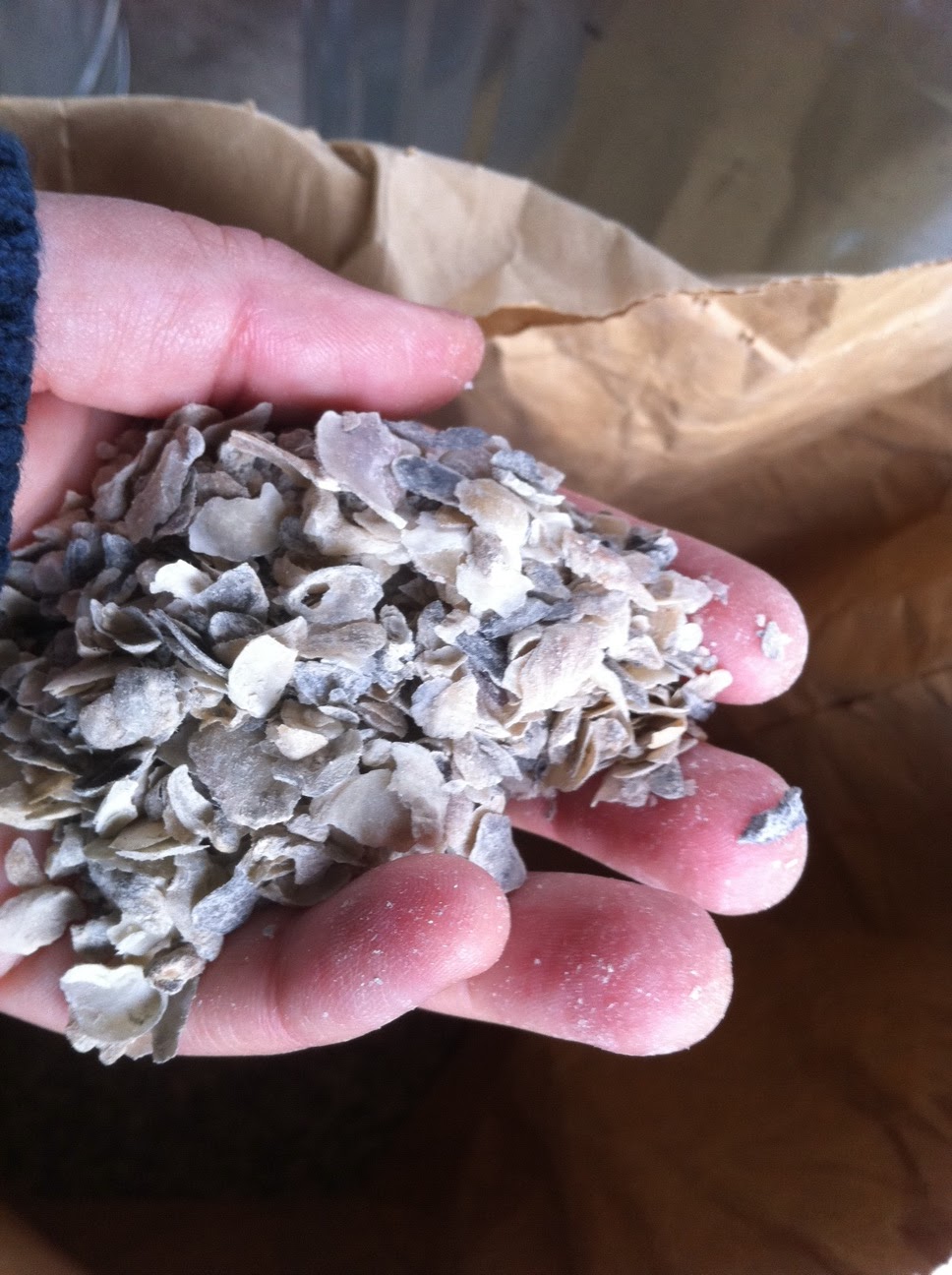
We also add oyster shells to our ladies' meal plan. I've tried several ways of providing them with these shells, but the least messy method I've used is to incorporate it straight into the feeder. This gets mixed at a 1:4 ratio with the standard feed. So filling the feeder is easy. Four scoops of feed, two scoops of weed seeds, one scoop of oyster shells. Repeat.


A bag this size will last a long time. We've had this one for a year already, and it's still 3/4 full. And heavy!! Ground up oyster shells are also great in your garden. They repel slugs and other soft-bodied pests, and they provide a great source of calcium and magnesium for plants. We don't bother since there are loads of egg shells to fill that need in our raised beds. 


Last, but possibly most important, access to fresh, green grass is really important to the dietary health of a chicken. Apart from fresh air, space to run and flap, crunchy insect snacks, and mite-busting dust baths, getting outside lets your chickens feel like chickens, not nuggets in a cage. If you can't let your hens out, or if the weather is just too nasty, make sure to give them plenty of treats to snack on. Cabbage leaves, melon rinds, and loads of other scraps from your garden and kitchen give them variety to nibble on, and they cut down on aggression during times of confinement. Chickens (like cows, sheep, and many other farm animals) also have the ability to digest grass and turn it into an edible product for humans to consume. This is our best way to get Omega 3 fatty acids. Check out this article from Eat Wild for more information on the benefits of consuming meat and eggs from grass-fed animals. The more they roam in the yard, the darker our hens' egg yolks get, and that's the whole reason we wanted to raise chickens in the first place.

Thursday, September 23, 2010

Is It the Weekend Yet?

You know you need a new job when.........


Clicking on the photo will enlarge it. Ignore the agenda items. Can you find the little mouse I hid in there? Honestly, I need to go home and plant something.

Thursday, September 9, 2010

The Annual Visit to the Fair

Each year we celebrate our anniversary with a trip to the Evergreen State Fair. I know, terribly romantic! Still, nothing makes me smile like baby piglets, stroking the mane of a Clydesdale, or watching the pygmy goat kids play.

But what about the chickens?


It's lots of fun to walk through the poultry and waterfowl barn. The roosters crow, some of the hens guard eggs in their cages, and the geese nip at children's fingers.


A lot of the chickens at the fair are banties. This little roo was quite the gentleman. I don't see the appeal of miniature chickens, but many urban farmers think they're great. Me? I love fat, fluffy, sassy hens.


This one looked so much like Winnie! Now that our girls are officially hens (except for the pullet crew of two), showing them at the fair or with poultry groups is more appealing. It can be a lot of work to get your chickie ready for dispalying and judging, but perhaps we'll try it!

LinkWithin

Related Posts with Thumbnails